 Goa Tours and Packages
Home › Guides › What Is There to See in Fontainhas, Goa?
What Is There to See in Fontainhas, Goa?
Fontainhas is Panjim's old Latin Quarter, a walkable grid of Portuguese-era houses on the hillside side of Panaji in central Goa. It sits right in the city, so from anywhere in Panjim you simply walk, and it is within walking distance of the Church of Our Lady of the Immaculate Conception.
Quick answer Fontainhas in a nutshell
Fontainhas is a conservation zone of narrow lanes and Portuguese-era houses painted in pale yellows and greens, at the foot of the Altinho Hills in Panjim. Entry is free and it is best explored on foot, with 2.5-hour guided heritage walks from $15.30 per person if you want a guide. Come early morning or evening for the best light and the coolest air.
Key takeaways
- Browse all goa tours and packages including the Fontainhas Heritage Walk in Panjim
- Book the Feni and Tapas Food Trail in Panjim to eat and drink through the quarter
- Pair the quarter with the nearby Church of Our Lady of the Immaculate Conception
- Keep reading for a self-guided route, food stops and photography tips
Guided Tours of Fontainhas
These walks take you through the Latin Quarter with a local guide, covering its history, architecture, food and drink. You can also walk the quarter on your own for free using the route below.
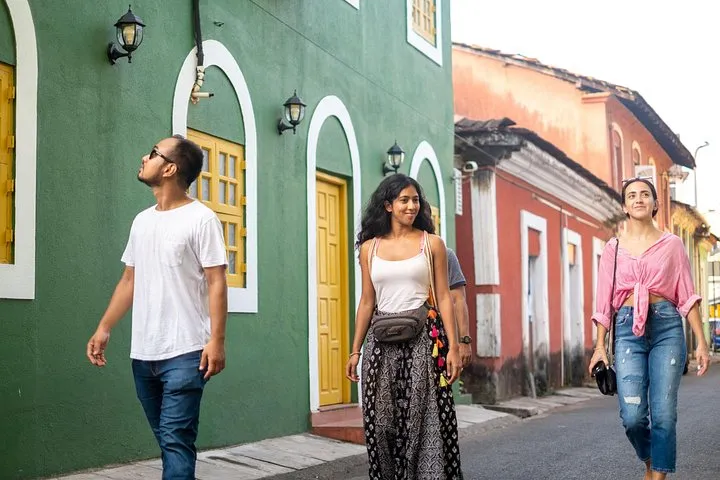 from $15.30
Most reviewed
Fontainhas Heritage Walk in Panjim
The most reviewed tour here: 2.5 hours through Fontainhas with Goan sweets, a drink and a short music performance.
Check Availability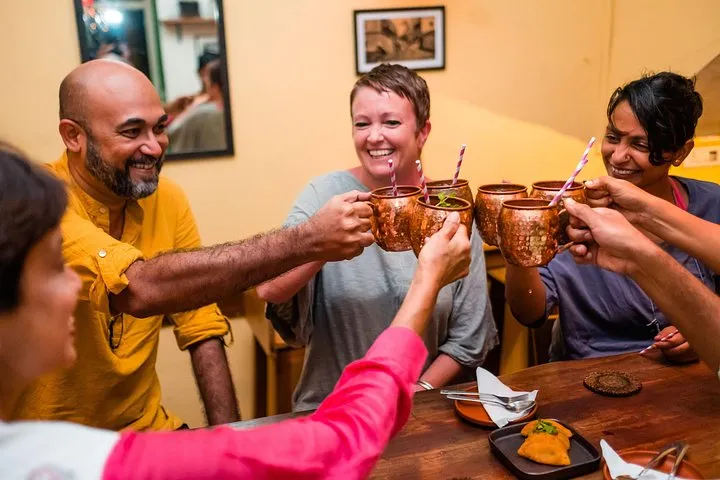 from $40.99
Feni and Tapas Food Trail in Panjim
A 3.5-hour evening in Panjim tasting feni and Goan tapas, with dinner and the drinks in the price.
Check AvailabilityWhat is special about Fontainhas Goa?
Fontainhas is where Portuguese is still most often heard on the street in Goa, and it preserves an unbroken quarter of Portuguese-era houses in the middle of Panjim.
The special thing about Fontainhas is that it never became a museum. It is a lively residential quarter where people live in the same painted houses their families have held for generations.
A living Portuguese quarter
William Dalrymple calls Fontainhas a small chunk of Portugal washed up on the shores of the Indian Ocean. Many residents still converse in Portuguese, and the houses in pale yellows, greens and blues line narrow, winding lanes. It is protected as a heritage conservation zone, which protects the streetscape you see today.
The quarter is small enough to cover on foot in a morning, yet dense with detail: azulejo name tiles, wrought iron balconies, tiny chapels and corner taverns. Locals hang washing between windows and children play in the lanes, so it feels lived in rather than staged.
Where the name and fame come from
The quarter is named for Fonte da Fenix, a natural spring at the foot of Altinho Hill that began to sprout around 1770. The refurbished Fonte Phoenix well still marks it at one of the quarter's houses.
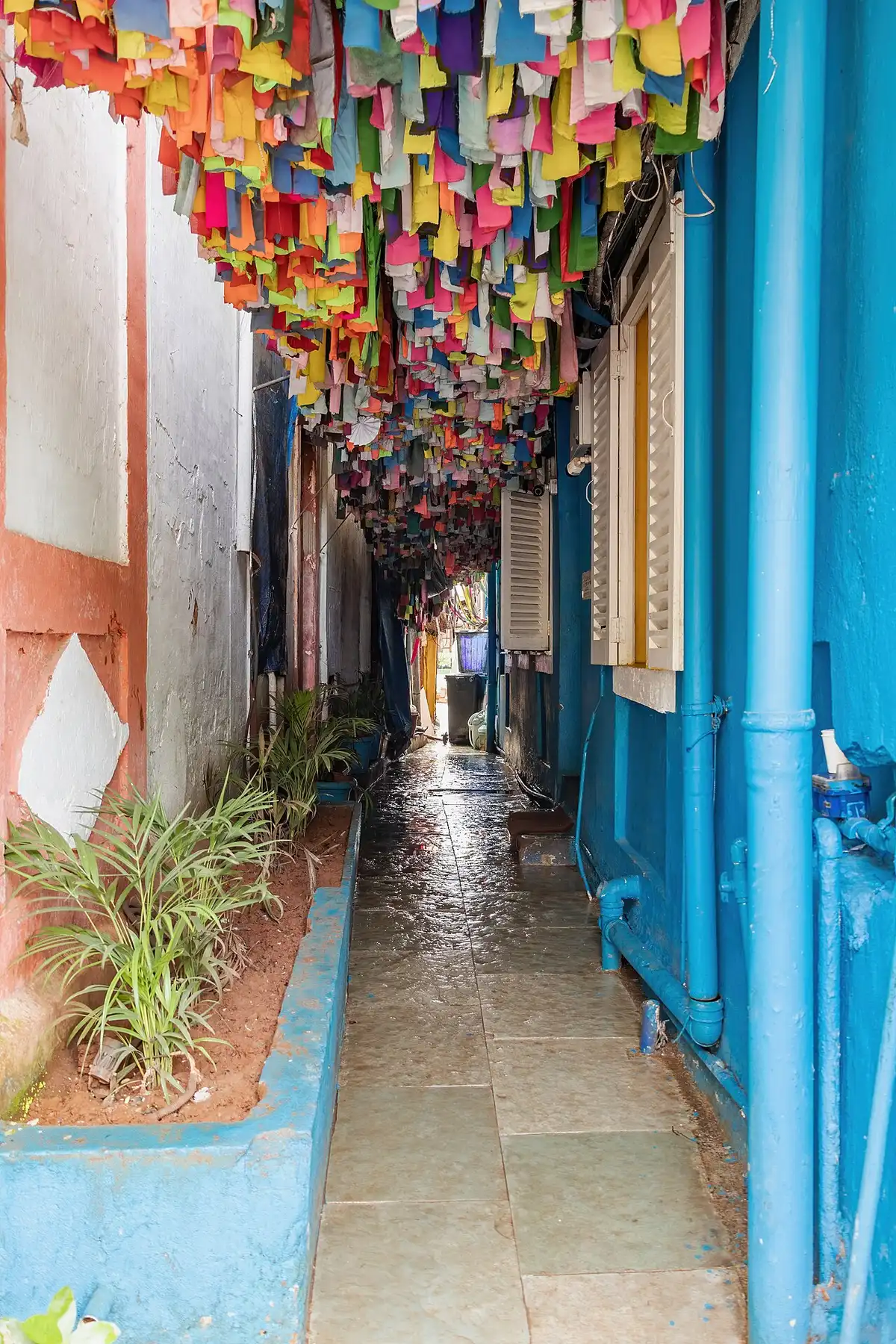
A narrow lane in Fontainhas, hung with coloured paper flags. Photo: iMahesh, CC BY-SA 4.0, via Wikimedia Commons
What does Fontainhas mean?
Fontainhas is Portuguese for little fountain, after the spring at the foot of Altinho Hill.
The name points straight at the quarter's oldest landmark.
The meaning
The name refers to the fountain, or spring, at the foot of Altinho Hill. A spring at the foot of the hill began to sprout around 1770, and the Fonte da Fenix well at one of the quarter's houses has since been refurbished.
Why are Fontainhas called Latin quarters?
They are called the Latin Quarter because Portuguese language, Catholic faith and Portuguese-style architecture have continued here since the eighteenth century.
The Latin label comes from the Latin-based language and Latin European culture that still shape the quarter.
A quarter built on Lisbon lines
Fontainhas was established in the late eighteenth century by Antonio Joao de Sequeira, nicknamed Mossmikar, a Goan expatriate who made his wealth in Mozambique. The quarter is patterned on Lisbon's Bairro Alto and was built on reclaimed land at the foot of the Altinho Hills, bounded on the east by Ourem Creek. It is where Portuguese is still most often heard on the street in Goa, which is what earns it the Latin Quarter name.
What is there to see in Fontainhas?
The sights are the painted houses and winding lanes, the Chapel of St Sebastian, Fonte Phoenix, Rua 31 de Janeiro and two art galleries.
Fontainhas has no ticketed monuments. The houses, chapels, streets and galleries are the attraction.
The five stops that matter
Start at the Chapel of St Sebastian, which contains a crucifix with open eyes linked to the Goan Inquisition and a wishing well. Then find Fonte Phoenix, the refurbished well from a natural spring. Walk Rua 31 de Janeiro, between Panjim Inn and La Maison Fontainhas, where the colonial-era architecture is densest.
Finish at the Gitanjali Art Gallery beside Panjim Inn and the Antonio Xavier Trindade permanent gallery at Fundacao Oriente.
| Stop | What you see |
|---|---|
| Chapel of St Sebastian | A crucifix with open eyes linked to the Goan Inquisition, plus a wishing well |
| Fonte Phoenix | A refurbished well fed by the natural spring that gave the quarter its name |
| Rua 31 de Janeiro | The densest colonial-era architecture, between Panjim Inn and La Maison Fontainhas |
| Gitanjali Art Gallery | An art gallery beside the Panjim Inn |
| Fundacao Oriente | The Antonio Xavier Trindade permanent gallery |
The houses themselves
Rows of Portuguese-era houses painted in pale yellows and greens line narrow, winding lanes. There is no entry fee to see them. Keep your camera ready but be patient, because the best views appear between parked scooters and open doorways rather than at any single viewpoint.
What is a good self-guided walk through Fontainhas?
A loop from the Immaculate Conception church area, through Rua 31 de Janeiro, past the Chapel of St Sebastian and Fonte Phoenix, and back via the galleries covers the quarter in about two hours.
You do not need a guide to enjoy Fontainhas, and the streets are easy to follow once you are inside them.
Stop by stop
Begin near the Church of Our Lady of the Immaculate Conception, which is within walking distance of the quarter. Climb into the lanes and make for Rua 31 de Janeiro, the street with the densest colonial-era architecture, and browse the shopfronts between Panjim Inn and La Maison Fontainhas. Pause at Confeitaria 31 De Janeiro, the quarter's favourite bakery, for a sweet from the wood-fired oven. Continue uphill to the Chapel of St Sebastian and its wishing well, then find Fonte Phoenix nearby. Loop back through the lanes to the Gitanjali Gallery beside Panjim Inn. If you have time left, add the Antonio Xavier Trindade gallery at Fundacao Oriente.
Allow about two hours for this route at a relaxed pace, longer if you stop to eat. The lanes are narrow and shaded in places, but the midday sun still bites, so carry water.
What food and drinks should I try in Fontainhas?
Try vindaloo, seafood curries, pork sorpotel and bebinca from the bakeries, and drink feni or a feni-based cocktail in a quarter tavern.
Fontainhas is as much an eating quarter as an architecture quarter, and the best stops are small and family run.
Bakeries, cafes and restaurants
Confeitaria 31 De Janeiro is the quarter's favourite bakery and makes traditional Goan sweets in a wood-fired oven, including bebinca. Popular cafes and stays include Bombay Coffee Roosters, Caravela and The White Balcao. For a proper meal, Viva Panjim, Verandah and Hotel Venite serve Goan and Portuguese cuisine, from vindaloo to seafood curries and pork sorpotel.
| Type of stop | Names to look for |
|---|---|
| Bakery | Confeitaria 31 De Janeiro, wood-fired Goan sweets |
| Cafes | Bombay Coffee Roosters, Caravela, The White Balcao |
| Goan and Portuguese dining | Viva Panjim, Verandah, Hotel Venite |
| Taverns | Antonios@31, The Joseph Bar |
Feni and the taverns
Taverns such as Antonios@31 and The Joseph Bar serve feni, the local cashew spirit, and feni-based cocktails. If you want the drinking side done for you, the Feni and Tapas Food Trail in Panjim covers the quarter's food and drink in 3.5 hours.
How much does it cost to visit Fontainhas, and what are the hours?
Nothing: Fontainhas is a free, open residential neighbourhood you can walk at any time, and only the galleries and tours charge.
There is no gate, ticket or opening hour for the quarter itself.
What you pay for
Walking the streets, seeing the Chapel of St Sebastian and photographing the houses costs nothing. Opening hours and entry fees for the Gitanjali Gallery and the Fundacao Oriente gallery are not stated. If you want a guided visit, Make It Happen sells a Fontainhas Heritage Walk covering history, food, music and architecture, and the same operator's Fontainhas Heritage Walk in Panjim runs 2.5 hours from $15.30 per person with free cancellation up to 24 hours before.
The Feni and Tapas Food Trail in Panjim costs $40.99 per person for 3.5 hours. Both carry strong reviews, 4.9 from 3018 and 5 from 455 respectively.
| Option | Cost | Time needed |
|---|---|---|
| Walking the quarter on your own | Free | About 2 hours |
| Fontainhas Heritage Walk in Panjim | $15.30 per person | 2.5 hours |
| Feni and Tapas Food Trail in Panjim | $40.99 per person | 3.5 hours |
What is the best time to visit Fontainhas, and how do I reach it from central Goa?
Go early morning or late afternoon for cool air and good light, and reach the quarter on foot from anywhere in Panjim or by road from the rest of Goa.
Fontainhas sits inside Panjim, so most visitors arrive without any transport plan at all.
Timing your visit
The lanes are narrow and shaded but Goa's midday heat is fierce, so early morning and late afternoon are the comfortable hours, and the low sun flatters the pastel walls. The quarter is busy with residents going about their day all morning, which is part of its charm. Avoid photographing into windows during the midday lull when shutters are closed.
Getting there
From central Goa, head for Panjim. Once in the city, Fontainhas is within walking distance of the Church of Our Lady of the Immaculate Conception, which makes an easy landmark. If you would rather have transport and commentary sorted, a guided walk such as the Fontainhas Heritage Walk in Panjim covers the quarter with a local guide.
Floating casinos on the Mandovi River, such as Deltin Royale and Casino Pride, are a short drive away if you want an evening after your walk.
What should I bring, who will love Fontainhas, and who should skip it?
Bring water, sun protection and a camera, ask before photographing residents or doorways, and come if you love architecture and food, but skip it if you want beaches or big-ticket sights.
Fontainhas rewards slow walkers and punishes anyone expecting a monument checklist.
Etiquette and what to pack
This is a lived-in residential quarter, so ask before photographing residents or doorways. Dress modestly near the chapel, keep your voice down in the lanes, and carry water plus a hat in the heat. Comfortable shoes help on the sloping streets toward Altinho Hill.
Who it suits
Fontainhas suits photographers, architecture fans, food lovers and anyone interested in Goa's Portuguese past. It also suits travellers with a free morning in Panjim, since it costs nothing and needs no booking. Skip it if you want beaches, nightlife or a full day of activities, because two to three hours covers the quarter well and there is little to do after dark beyond dinner and a tavern.
What else is nearby to Fontainhas?
The Church of Our Lady of the Immaculate Conception is within walking distance, and the Mandovi River floating casinos Deltin Royale and Casino Pride are a short drive away.
Fontainhas sits well for combining with the rest of Panjim in one day.
Pairing your walk
Start at the white steps of the Church of Our Lady of the Immaculate Conception, walk into the quarter, and end with lunch in one of the Goan restaurants. In the evening, the floating casinos on the Mandovi River are a short drive away. For more ideas across the state, browse goa tours and packages.
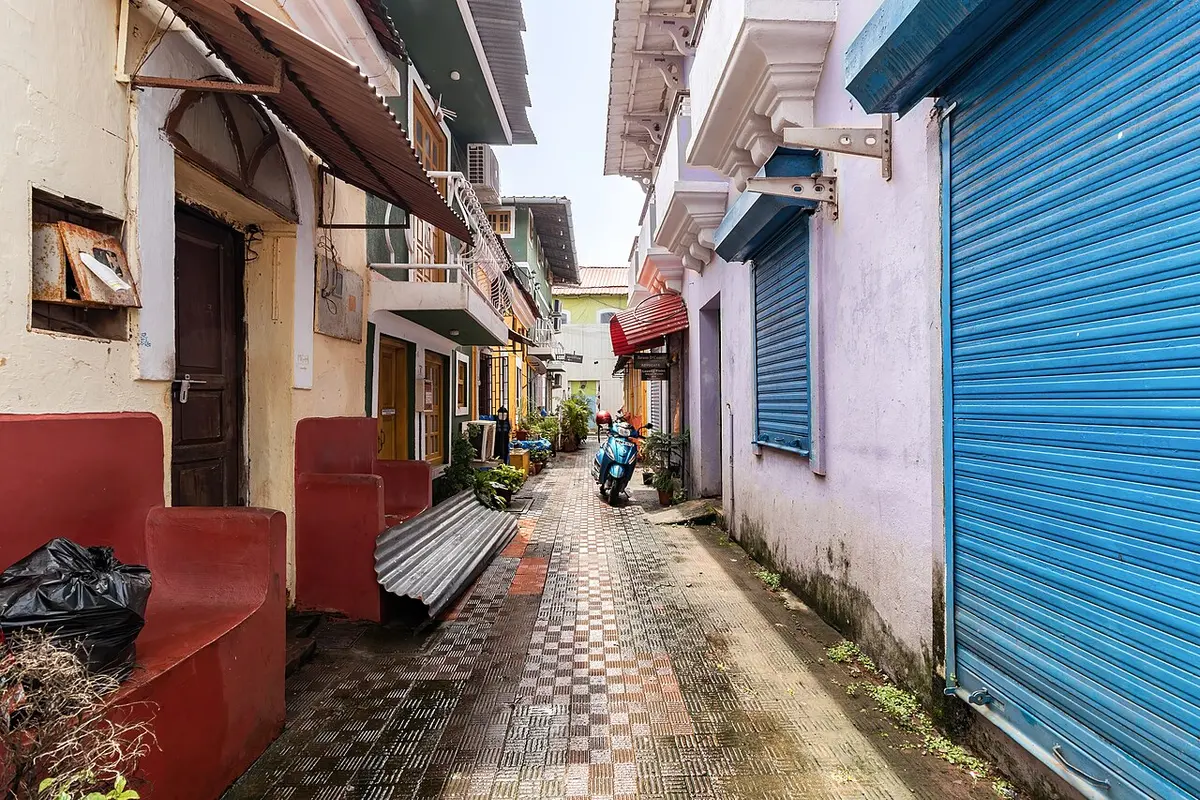
Pastel Portuguese-era houses line the tiled lanes of Fontainhas in Panjim. Photo: iMahesh, CC BY-SA 4.0, via Wikimedia Commons
Fontainhas FAQ
What is special about Fontainhas Goa?
It is a conservation zone of Portuguese-era houses in pale yellows and greens where Portuguese is still heard on the street, and the Fontainhas Heritage Walk in Panjim brings its history to life.
What does Fontainhas mean?
Fontainhas is Portuguese for little fountain, after the Fonte da Fenix spring at the foot of Altinho Hill.
How do you pronounce "Fontainhas"?
In Portuguese it is fon-ta-EEN-yash, with the stress on the long "i" and a soft "sh" at the end. It means little fountain.
Why are Fontainhas called Latin quarters?
Because Portuguese language and culture have continued here since the quarter was established in the late eighteenth century, and Portuguese is still heard on its streets.
Is Fontainhas free to visit?
Yes. It is an open residential quarter with no entry fee, best explored on foot. Ask before photographing residents or doorways.
How long do I need in Fontainhas?
About two hours covers the main stops on your own, or book the 2.5-hour Fontainhas Heritage Walk in Panjim or the 3.5-hour Feni and Tapas Food Trail in Panjim.
How do I reach Fontainhas?
It lies inside Panjim, within walking distance of the Church of Our Lady of the Immaculate Conception, so most visitors arrive in the city first and walk in.
More Guides
- How Do You Visit the Basilica of Bom Jesus in Old Goa?
Visit the Basilica of Bom Jesus in Old Goa in 2027: opening hours 9.00am to 5.00pm, mass times, the tomb of St Francis Xavier and tips. Plan your visit.
- What Are the Best Beaches in Goa?
Plan the beaches in Goa for 2027: north vs south, quiet and couple picks, hours and rules, with a 3-day tour from $98. Start here.
- How Do You Visit Dudhsagar Falls from Goa?
Dudhsagar Falls stands 310m tall, 60km from Panaji. Compare jeep safaris, entry fees, trek rules and the best season, then book your Goa day trip in 2027.